
Humanizing AI: The Impact of Cultural Nuances on Language Processing
Integrating cultural frameworks into NLP systems addresses misinterpretations in sentiment, intent, and humor by embedding worldviews, idioms, and politeness norms—boosting trust, relevance, and equity for diverse users.
AI systems today often promise seamless cross-lingual and cross‐cultural communication—but too frequently they deliver literal translations that miss the mark on meaning, intent, and tone. For example, a European airline’s chatbot rendered the Japanese greeting “お疲れ様です” (“you must be tired”) instead of conveying its service-oriented appreciation, leaving travelers puzzled. From a customer service bot that treats polite indirectness as uncertainty to a sentiment analyzer flagging regional humor as negativity, these failures aren’t just bugs; they stem from models built on monolithic assumptions—treating language as a static codebook where words map one-to-one to meanings regardless of cultural context. Humanizing AI demands we move beyond word-level mappings to worldviews shaped by history, values, and social norms.
"Language models that ignore culture risk fluency without understanding, offering translations that speak words but not worlds."
1. The Case for Cultural Awareness in NLP: Beyond Words to Worldviews
Contemporary large language models excel at pattern recognition across massive text corpora, yet they often assume a universal semantics that glosses over regional and cultural divergences. Without culture-specific context, systems can conflate tone with meaning:
- Sentiment and intent: “That’s interesting…” signals polite skepticism in British English but genuine curiosity in American usage; indirect refusals in East Asian settings preserve harmony yet get overridden by chatbots trained on direct requests.
- Humor and idioms: African American Vernacular English features rhetorical devices that literal pipelines may label as off-topic or abusive.
The result is degraded engagement, eroded trust, and potential alienation of underrepresented groups. Embedding cultural nuance can yield:
- Higher relevance: Responses anchored in local conventions feel native, not translated.
- Improved trust: Users perceive the system as respectful of their norms and worldviews.
- Equity: Models calibrated to diverse linguistic communities reduce digital divides and foster inclusion.
Having established why cultural nuance is essential, we turn to how to translate cultural dimensions into concrete model inputs.
2. From Theory to Features: Translating Cultural Dimensions into Model Inputs
Decades of cross-cultural research offer frameworks to map abstract dimensions to language phenomena. Hofstede’s individualism vs. collectivism correlates with directness in requests; Hall’s high-context vs. low-context predicts reliance on shared background knowledge. These theories inform feature design:
- Idioms and metaphors: Building lexicons of region-specific expressions.
- Politeness norms: Capturing honorifics, formality levels, and indirect speech acts.
- Narrative conventions: Recognizing culturally salient topics and storytelling structures.
Strategies for encoding cultural signals include:
- Embedding augmentation: Appending culture-tag vectors during pretraining.
- Feature injection: Adding linguistic annotations (e.g., politeness level).
- Modular adapters: Attaching lightweight, culture-specific layers to a shared backbone.
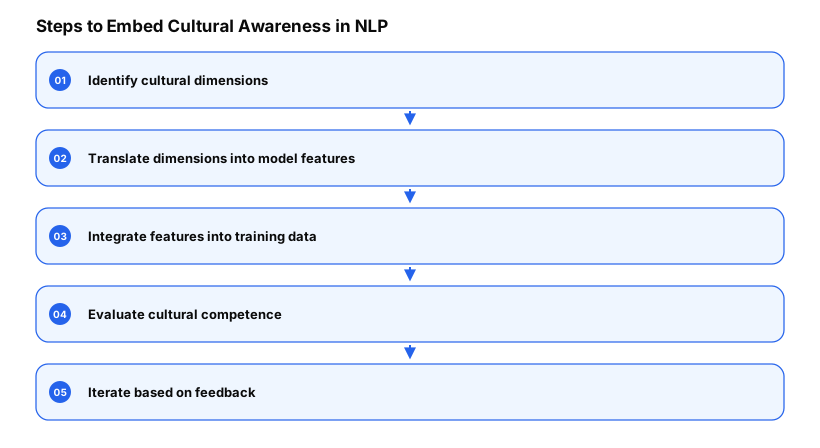 Conceptual framework based on the article's discussion of cultural modeling in NLP.
3. Data Strategies: Sourcing, Annotation, and Bias Mitigation
Under-resourced languages and dialects face acute data scarcity, leading to poorer performance and reinforcing inequities. For instance, in a Quechua case study, researchers harvested community radio transcripts and folk narratives to build a corpus capturing authentic usage. Key considerations:
- Representative corpora: Mining local media, forums, and literature.
- Annotation protocols:
- Crowdsourcing surfaces diverse perspectives but risks inconsistent judgments on implicit norms.
- Expert annotators offer deeper insight at higher cost and slower turnaround.
- Bias mitigation: Guard against overgeneralizing small samples that might cement stereotypes.
Even well-intentioned cultural modeling can inadvertently amplify harmful tropes. To prevent this, teams must combine automated patterns with ethnographic review and iterative user feedback.
4. Architectures and Training Paradigms for Cultural Sensitivity
Once cultural features and corpora are ready, practitioners choose among several approaches:
- Fine-tuning tailors the entire model to a culture but requires maintaining multiple versions.
- Adapter modules add small culture-specific components to a shared core, simplifying updates.
- Multi-task learning shares representations across cultures while customizing objectives, though it may dilute specialized features.
- Techniques like meta-learning help models adjust quickly to new contexts but can be complex to set up.
Each choice involves trade-offs in compute overhead, version control, and development complexity. A balanced strategy often layers a stable core with modular cultural extensions.
5. Measuring Success: Evaluating Cultural Competence in NLP
Standard metrics like BLEU or top-k accuracy often miss cultural correctness. Effective evaluation hinges on:
- Context-aware test suites:
• Role-play scenarios requiring contextually appropriate utterances.
• Paraphrase tasks that preserve local idioms and politeness. - Human-in-the-loop studies:
• Cross-cultural user research assessing naturalness and trust.
• A/B tests measuring engagement and satisfaction across demographics.
Benchmarks must reflect cultural competence as a first-class objective.
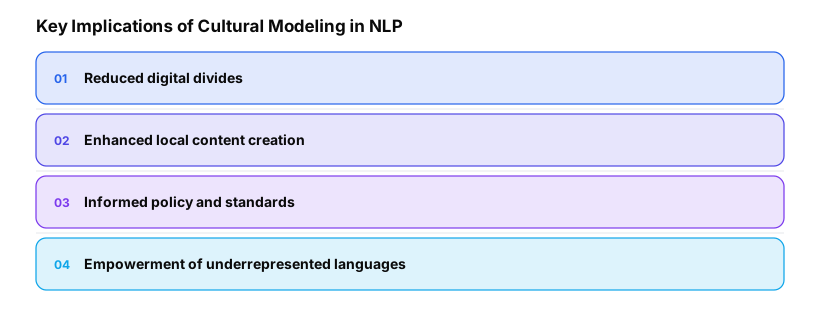 Conceptual insights derived from the article's exploration of cultural impacts in AI.
6. Ethical and Social Implications: Stereotypes, Privacy, and Power
Cultural modeling walks a fine line between personalization and profiling:
- Stereotype reinforcement: Broad patterns can slip into overgeneralizations.
- Privacy risks: Inferring sensitive attributes (e.g., religion) from language raises concerns.
- Power dynamics: Who defines cultural norms? Dominant groups risk codifying their perspectives as universal.
Balancing personalization with privacy calls for transparent opt-in systems, on-device processing where feasible, and strong data anonymization—so users benefit from cultural tuning without exposing sensitive information. Governance frameworks should document how cultural data is sourced, annotated, and used, and enable user opt-out. Community oversight and impact assessments can help safeguard against misuse.
7. Second-Order Impacts and Future Directions: Toward Inclusive Language AI
Culturally aware NLP has ripple effects beyond translation or chatbots:
- Reducing digital divides: Tailored interfaces empower speakers of underrepresented languages to access services on equal footing.
- Local content creation: Better tools fuel grassroots publishing, education, and cultural preservation.
- Policy and standards: Shared benchmarks and annotation schemas can democratize cultural modeling.
Roadmap for the next decade:
- Establish local annotation hubs with community linguists to curate and govern data.
- Launch open competitions and hackathons focused on culture-specific model improvements.
- Develop shared taxonomies and open repositories for cultural features and best practices.
Further reading
[1] Cultural Sensitivity in AI Language Learning: Using NLP to Enhance Language Understanding Across Cultural Contexts — https://doi.org/10.54254/2753-8818/2025.20110 [2] AI Impact on Local Culture: Language — https://ipil.blog.uni-hildesheim.de/2025/01/16/ai-impact-on-local-culture-language/ [3] How AI Misses Cultural Nuance in Translation — https://www.facebook.com/prdaily/posts/ai-can-translate-words-it-cant-translate-culture-a-new-piece-highlights-how-ai-g/1381655494006876/ [4] How Language Gaps Constrain Generative AI Development — https://www.brookings.edu/articles/how-language-gaps-constrain-generative-ai-development/